
Required Minimum Distributions: What Retirees Need to Know
Required Minimum Distributions: What Retirees Need to Know
Think of tax deferrals like hitting the snooze button on a tax bill. For years - often decades - many contributions may be made pre-tax, and investment growth can remain tax-deferred while the money stays in the account.
But the snooze button doesn't work forever.
Once you reach the applicable age, the IRS generally requires you to begin taking out a portion of certain tax-deferred retirement accounts each year. Those withdrawals are called Required Minimum Distributions, or RMDs.
The important part: an RMD does not mean you have to spend the money. It simply means the tax-deferred account can no longer keep every dollar tucked away indefinitely.
What Is an RMD?
A Required Minimum Distribution is the minimum amount you generally must withdraw each year from certain tax-deferred retirement accounts once you reach the applicable age. These rules can apply to traditional IRAs, SEP and SIMPLE IRAs, traditional 401(k)s, 403(b)s, and certain other employer plans.
Why? Many contributions were made with pre-tax dollars, and the growth was tax deferred. The key word is deferred: the taxes were postponed, not necessarily eliminated.
When Do RMDs Start?
The starting age has changed several times, which is why people may remember hearing 70½, 72, 73, or 75. Under current law:
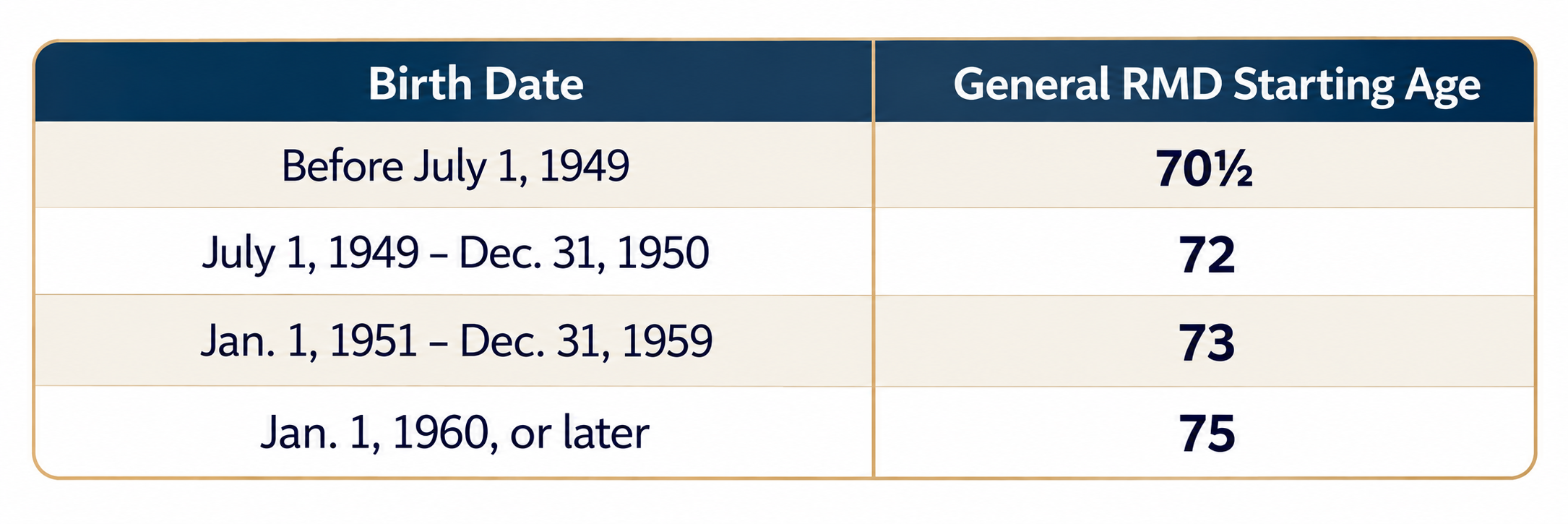
For most people approaching RMD age today: born from 1951 through 1959 generally means age 73; born in 1960 or later generally means age 75.
Your first RMD is generally for the year you reach the applicable age, although you may be allowed to delay that first distribution until April 1 of the following year. Delaying can mean taking two taxable RMDs in the same calendar year. Certain workplace plans may let some still-working employees delay RMDs, while IRAs generally do not provide that same working exception.
How Much Do You Have to Take Out?
For most IRA owners, the calculation starts with the account value on December 31 of the previous year and divides it by an IRS life-expectancy factor.
Example: Assume you are 73 and your traditional IRA was worth $500,000 at year-end. The current Uniform Lifetime Table uses a factor of 26.5 at age 73:
$500,000 ÷ 26.5 = approximately $18,868
That would be the approximate RMD for the year. As you get older, the divisor generally becomes smaller, which means a larger percentage of the account must be distributed.
What If I Don’t Need the Money?
An RMD requires money to leave the retirement account, but it does not require you to spend it.
Likewise, an RMD does not mean you must spend the money. After the required amount leaves the retirement account and any applicable taxes are addressed, you could use it for living expenses, save it, reinvest it in a taxable account, give money to family, or use it for charitable giving.
What About Roth Accounts and Charitable Giving?
Roth IRAs do not have lifetime RMDs for the original owner. Designated Roth accounts in 401(k) and 403(b) plans also generally avoid lifetime RMDs for the original owner under current law. Beneficiaries can face different rules.
For charitably inclined IRA owners, a Qualified Charitable Distribution (QCD) may also be worth discussing. When the requirements are met, money sent directly from an IRA to a qualified charity can count toward an RMD while potentially keeping that amount out of taxable income.
Plan Before RMDs Begin
One of the biggest mistakes is waiting until RMD age to start planning. Someone who retires years before RMDs begin may have a window of lower taxable income. Depending on the situation, that period may create opportunities to consider Roth conversions or other tax-planning strategies before required distributions begin.
That does not mean a Roth conversion is automatically the right move. Current and future tax brackets, Medicare premiums, Social Security, other income, estate-planning goals, and many other factors should be considered together.
The Bottom Line
At their core, RMDs are simply a required annual withdrawal from certain tax-deferred retirement accounts once you reach the applicable age.
The more important question is what you do next. Do you need the distribution for income? Should taxes be withheld? Could the money be reinvested? Would charitable giving make sense? Could planning before RMD age help reduce future distributions?
If you’re approaching RMD age, already taking distributions, or simply want to understand what your future RMDs could look like, the team at Callesen Wealth Management would be happy to help you explore how they fit into your overall retirement plan.
Sources: Internal Revenue Service, “Retirement Topics - Required Minimum Distributions (RMDs)” and IRS Publication 590-B.
This material is provided for informational and educational purposes only and should not be considered individualized investment, tax, or legal advice. Tax laws and regulations may change, and individual circumstances vary. Please consult the appropriate financial, tax, and/or legal professionals regarding your individual situation.
Investing involves serious risks and past performance is no guarantee of future performance or success. This is not an offer to buy or sell securities and nothing contained herein should be interpreted as a recommendation regarding any investment or investment strategy. Before making any decision to invest, first read the relevant disclosures and important information provided to you. The information given herein is taken from sources that IFP Advisors, LLC, dba Independent Financial Partners (IFP) and, IFP Securities LLC,dba IFP, and its advisors believe to be reliable, but it is not guaranteed by us as to accuracy or completeness. This is for informational purposes only and in no event should be construed as an offer to sell or solicitation of an offer to buy any securities or products. Please consult your tax and/or legal advisor before implementing any tax and/or legal related strategies mentioned in this publication as IFP does not provide tax and/or legal advice. Opinions expressed are subject to change without notice and do not take into account the particular investment objectives, financial situation, or needs of individual investors. This report may not be reproduced, distributed, or published by any person for any purpose without IFP’s express prior written consent.